Ed Techsploration
  • Educational Technology
    • Educational Technology
    • Technology & the Common Core >
      • Technology & the Common Core
      • Research, Literacy and Technology
    • Flipped Classroom
    • International Projects >
      • Maya-Tech Examples
  • Resources
    • Apps & Digital Tools
    • Additional Resources
  • Workshops & Trainings
    • Overview
    • Professional Development
    • Workshop Offerings
    • Prior Trainings and Consultations
  • Blog
  • About
    • About
    • Contact
  • WORKSHOP PARTICIPANTS
  • Infographics
  • New Page

The New Digital Divide

02/15/2014

I live in the heart of Silicon Valley, birthplace of the computer revolution. Yet within a 20 mile radius, one is confronted by the persistent reality of the ‘digital divide’, the gulf between those with digital access and savvy and those without. The differences are enormous: Several districts have 1:1 iPad programs extending from high school down into the upper elementary levels, while only miles aware are districts with only old-style computer labs housing antiquated equipment. 

Technology Leads to Growing Disparity?

It does not take being an educational technology specialist to be aware of the powerful consequences of this discrepancy. The Pew Research foundation last year found that 84% of teachers agree that “Today’s digital technologies are leading to greater disparities between affluent and disadvantaged schools and school districts.”  While only a little over half (54%) of the teachers believed that their students had adequate access to digital tools at school, less than a fifth (18%) say the most of their students have adequate facilities at home.

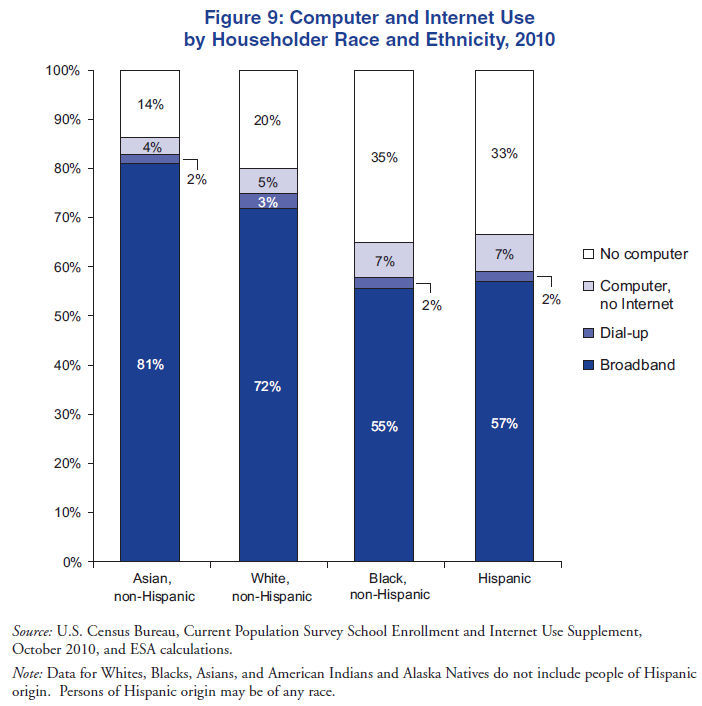
According to 2010 census data, this divide is most pronounced across income levels, followed by discrepancies based on rural/urban and racial grouping.
Somewhat offsetting this data about computer ownership and broadband access are recent reports showing high and more equitable levels of internet access via smart phones across income and racial divisions. This mitigates the concern to some level, but few teachers would suggest that smart phones level the playing field when it comes to projects that involve developing a wiki sites, crafting a multimedia presentations or other exercises involving more complex content creation.

Information Use - A Greater Divide

Although the gaps in access are significant, attention now focuses more on the manner in which technology is being used by different groups in our society and the impact this has on the “education-based knowledge gap”. Students who only play non-educational video games will benefit far less from the same technology than those who engage in research, content creation and other educationally-productive activities. From Wei & Hindman’s study, “Does the Digital Divide Matter More..."
Picture
Picture
“… socioeconomic status is more closely associated with the informational use of the Internet than with access to the Internet. ... More importantly, the differential use of the Internet is associated with a greater knowledge gap than that of the traditional media. These findings suggest that the digital divide, which can be better defined as inequalities in the meaningful use of information and communication technologies, matters more than its traditional counterpart”

Computer Science - The Digital Chasm

This potential for technology access and use to magnify the gap between the haves and have-nots is especially apparent when one looks at content creation and especially computer programming skills. Here the discrepancy is a gulf. A recent “National Call to Action” highlighted this concern, pointing out the lack of attention paid by the Common Core to computer science education. Only 14 states include programs that come at all close to recommended standards for secondary level computer science programs. Not surprisingly, African Americans, Latinos and women are significantly under-represented in these programs.  The study describes this lack of access to K–12 computer science education as “privileged knowledge,” and identifies it as a significant social justice issue for the 21st Century.

Call to Action

Certainly initiatives that improve infrastructure and bring technology resources into rural or impoverished communities will help. Unfortunately with computerized assessments now mandated by the Common Core, many of these resources will be consumed by testing and test preparation - an issue in its own right. As important, and most often neglected, is the need for quality training of staff so that all available resources are used to their maximum potential.  A future blog will explore possible strategies to address this growing concern, but in the meanwhile, what are your thoughts about how to turn this around?

What are your experiences with digital inequities? What can be done?
(Tip - check "I'd rather post as guest" if you don't want to create a "Disqus" account)
Return to Blog Posts
comments powered by Disqus
Follow on Twitter


Google+
Top Blog Posts:
  • Top New Google Add-Ons for Docs 
  • Digital Texts and the New Literacy
  • The New Digital Divide  Increases Inequity
Workshop Schedule
Google For Education Certificated

Contact
Copyright 2015-18. Devin Hess, Ed Tech'sploration